
 ·
3 minute read
·
3 minute read
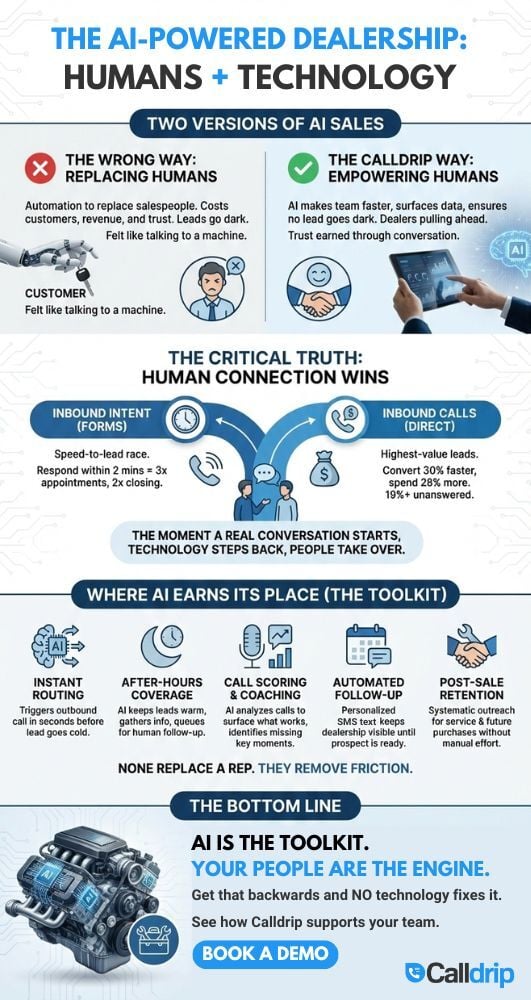
There's a version of AI-powered dealership sales that works. It makes your team faster, surfaces better data, and ensures no lead goes dark. Dealers using it are pulling ahead.
There's another version being sold on trade show floors and in vendor demos right now — one that promises to automate your way out of needing salespeople. That version will cost dealers customers, revenue, and trust they can't easily get back.
Knowing the difference matters more than it did 12 months ago.
Two Channels. Both Require a Human at the Right Moment.
Dealership lead response happens across two distinct channels that often get conflated — and that's where strategy breaks down.
Speed-to-lead is the race to respond when a prospect submits a form. They've raised their hand. They're comparing you to three other dealerships right now. Calldrip's data shows dealerships that respond within 2 minutes are 3x more likely to set an appointment and 2x more likely to close. Every minute of delay cuts those odds significantly. This is an outbound action triggered by inbound intent — and the goal is to get a real person on the phone before a competitor does.
Inbound calls are a different motion. A prospect calls your store directly. They've already done research. A Forrester study found these buyers convert 30% faster, spend 28% more, and have a 28% higher retention rate than other channels. These are your highest-value leads — and more than 19% of them go unanswered or get abandoned due to hold times and poor call routing.
Both channels have the same problem: dealerships are leaving the outcome to chance instead of building a reliable process around them. And both channels share the same critical truth — the moment a real conversation starts, your technology steps back and your people take over.
What Happens When You Remove the Human
AI-driven sales tools promise efficiency. Some deliver it. But when dealers use automation to replace human conversation rather than support it, the results are predictable.
Customers buying a vehicle — often a $40,000+ decision — want to talk to someone who listens, reads the situation, and earns their trust. When they hit an AI chatbot that can't answer a specific question, or a scripted sequence that ignores what they actually said, they don't complain. They go to the next dealership.
The damage is quiet. Leads just don't convert. Customers don't call back. Reviews trend toward "felt like I was talking to a machine." By the time it shows up in the numbers, you've already lost customers who are now loyal to a competitor who picked up the phone.
The dealers who replace their BDC teams with bots, gut their phone coverage, or let AI handle the appointment ask — they're running an experiment with their most valuable leads. The data does not support optimism about how it ends.
Where AI Actually Earns Its Place
The right question isn't "can AI replace our sales team?" It's "what can AI do so our sales team focuses on closing?"
Here's where it works:
- Instant lead response routing — the moment a form comes in, AI triggers an outbound call to connect a rep within seconds, before the lead goes cold
- After-hours and overflow coverage — AI keeps leads warm when your team isn't available, gathers basic information, and queues them for immediate human follow-up when the dealership opens
- Call scoring and coaching data — AI analyzes every call to surface what's working: which conversations lead to appointments, which ones stall, where reps are missing key moments like the trade-in conversation or the direct appointment ask
- Automated follow-up sequences — 64% of leads die from neglect, not bad pitches. Personalized SMS and email follow-up keeps your dealership visible until the prospect is ready to move
- Post-sale retention — systematic outreach that stays in front of customers for service and future purchases without requiring your team to manually manage it
None of these replace a rep. They remove the friction that prevents reps from spending time where they're most effective: in real conversations with motivated buyers.
The Data Your Dealership Is Already Sitting On
Every call your store receives contains information about what's working and what isn't. Which campaigns are driving calls that convert to appointments? Which reps are asking for the appointment and which aren't? What's happening in the conversations where a hot lead doesn't book?
Most dealerships have no answer to these questions because the data lives in recordings nobody reviews, or it vanishes the moment a call ends.
AI-powered call scoring and tracking changes that — not by automating the sale, but by making the invisible visible. Managers get real coaching data. Reps get specific feedback. The whole team improves on a shorter timeline.
That's AI working correctly. Quietly, in the background, making your people sharper.
The Bottom Line
The dealerships that win the next few years will use AI. They'll also have strong salespeople who answer the phone, respond to leads fast, and know how to have a conversation that closes.
The ones that hand the keys to automation and strip out the human layer are going to find out what customers do when they feel like a ticket number. Hint: they buy somewhere else.
AI is the toolkit. Your people are the engine. Get that backwards and no amount of technology fixes it.
See how Calldrip supports your team without replacing them. Book a demo.
.png)
.png)
-1.png)